
The Mumbai-based real estate developer Oberoi Realty has been one of the top-performing companies in its segment and most brokerage remains bullish on the stock. The company's stock price is 52 per cent in the last 12 months beating the broader market by a huge margin. The benchmark BSE Sensex is up just 6.5 per cent during the period.

NTPC was the top gainer in the Sensex pack, rallying around 4 per cent, followed by Titan, SBI, HUL, IndusInd Bank and UltraTech Cement. NSE Nifty advanced 63.15 points to 15,746.50.

The total number of unique investors directly investing in the stock market has surged to 80 million for the first time, with the latest 10 million additions taking place in just eight months, according to data shared by the National Stock Exchange (NSE), the country's largest bourse. "The 80 million unique PAN (permanent account number) investors correspond approximately to around 50 million unique households in India amounting to around 17 per cent households directly investing in the Indian stock market via NSE's extensive nationwide network of trading members," said the exchange. In 2021, the number of domestic households were pegged at 300 million.

Hyundai Motor India (HMIL) raised Rs 8,315 crore from anchor investors on Monday, setting the stage for the country's biggest-ever maiden share sale. The Indian arm of the South Korean carmaker Hyundai Motor Company (HMC) allotted 42.4 million shares to 225 funds at Rs 1,960 apiece, the higher end of its price band. Among the investors receiving allotments were the Singapore government's sovereign wealth fund (GIC), New World Fund, and Fidelity.

Benchmark indices bounced back on Wednesday after a two-day decline, with the Sensex and Nifty climbing nearly 1 per cent each, tracking a positive trend in European markets. Buying in IT and bank stocks also supported the recovery in equities. The 30-share BSE benchmark jumped 547.83 points or 0.99 per cent to settle at 55,816.32.

The stock of the country's largest listed oral care company -- Colgate-Palmolive (India) Ltd is up 18 per cent over the past month. The gains were led by better than expected June quarter (Q1) performance of the 2023-24 financial year (FY24) and growth revival expectations of the oral care category. The company's volume growth is pegged at 5-8 per cent in Q1FY24. This is the second consecutive quarter of volume growth.

The Securities and Exchange Board of India has charged HDFC Bank with not exercising due diligence, resulting in several demat accounts being opened under fictitious names leading to the IPO scam.

Cash trading volume declined in 2022, even as benchmark indices outperformed their peers. The average daily trading volume (ADTV) for the cash segment fell 18 per cent year-on-year to Rs 61,392 crore (NSE and BSE combined). The ADTV for the futures and options (F&O) segment (NSE and BSE combined) stood at Rs 125 trillion (notional turnover), up 117 per cent from the previous year.

Adani Ports, NTPC, Infosys, Hindustan Unilever, HCL Technologies and Sun Pharma were among the other big gainers. However, Larsen & Toubro, Bajaj Finance, State Bank of India, Axis Bank and HDFC Bank were amonh the major laggards.

The rupee depreciated by 9 paise and settled at its all-time low level of 83.13 against the US dollar on Wednesday, weighed down by a surge in crude oil prices and strong American currency. Forex traders said the Indian rupee depreciated as the US dollar rose to the highest levels in six months. Moreover, elevated crude oil prices also weighed on rupee.

Equity indices frittered away a good start to close with modest losses on Monday, pressured by heavy selling in metal stocks after the government imposed export duties on steel-making raw materials to curb soaring prices. The 30-share BSE Sensex opened strong and gained momentum as the session progressed, but came under severe selling pressure in afternoon trade to close 37.78 points or 0.07 per cent lower at 54,288.61. On similar lines, the broader NSE Nifty slipped 51.45 points or 0.32 per cent to end at 16,214.70.

Ask rediffGURU and PF and MF expert Janak Patel your mutual fund and personal finance-related questions.

'Credit card debt comes with high interest cost and stringent penalties.' 'If you do not repay on time, the costs balloon.'

Customers frequently sign without reading the terms and conditions, resulting in a poor understanding of coverage, and eventually leading to partial payouts

Ask rediffGURU and PF expert Nitin Narkhede your mutual fund and personal finance-related questions.

With the markets scaling new highs, as many as 43 stocks from the Nifty50 index and 27 of the 30 scrips that are part of the S&P BSE Sensex are trading above their respective 200-day moving average (DMA). The 200-DMA is seen as one of the most relevant trend indicators by investors and traders, who believe that stocks and indices trading above this level possess strength and are likely to rally in the short to medium term, while the ones trading below this level are viewed as bearish and expected to see a sell-off. Wipro, UPL, Kotak Mahindra Bank, Hindalco, Infosys, Cipla, and Adani Enterprises are the only stocks from the Nifty50 pack that are still below their respective 200-DMA, the exchange data suggests.

Imagine transforming a modest Rs 10,000 monthly investment into a steady Rs 1 lakh monthly income in your retirement years. This is the power of compounding -- a strategy that rewards you for starting early and staying consistent with your investments, says Ramalingam Kalirajan.

Mutual funds (MFs) lapped up shares of new-age businesses in April at a time when most of these stocks have recovered sharply from their 52-week lows. Nykaa and Zomato featured in the list of top 10 most bought shares by MFs last month, with fund houses' holdings in these two stocks rising by over Rs 1,100 crore, shows a report by Nuvama Alternative & Quantitative Research. Shares of Zomato had staged some recovery in April after remaining subdued for an extended period.

The 2023-24 (FY24) July-September quarter (second quarter, or Q2) proved to be a mixed period for asset management companies (AMCs). While the two largest listed AMCs, HDFC and Nippon, reported robust growth in both revenue and profits, the other two, Aditya Birla Sun Life and UTI, experienced profit declines. HDFC AMC reported an 18 per cent year-on-year increase in Q2 revenue to Rs 765 crore, while Nippon's revenue rose 15 per cent to Rs 475 crore.
Asset Management Companies (AMCs) demonstrated improved business metrics in the first quarter ended June 2023 (Q1FY24), but a sharp run-up in stocks leaves little room for further upside in the immediate term, say analysts. During this quarter, HDFC AMC reported a 10 per cent year-on-year (YoY) rise in revenue from operations at Rs 575 crore. Nippon India's revenue from operations went up 12 per cent to Rs 354 crore.

Most of the Adani Group companies fell in the morning trade on Friday and flagship Adani Enterprises tumbled 10 per cent after index provider MSCI decided to reduce the weightage of four firms in its indices following a review. Amid volatile trading in the market, seven Adani Group firms were in the negative territory while three others were in the green. Adani Enterprises plunged 10 per cent to Rs 1,734.60 per share, its lower price band on the BSE, and the company's market valuation dropped to Rs 2.14 lakh crore.

The rupee on Thursday closed at its all-time low of 78.32 (provisional) against the US dollar as strong American currency and persistent foreign fund outflows weighed on investor sentiments. At the interbank foreign exchange market, the local currency opened at 78.26 and finally settled at its all-time low 78.32, unchanged from its previous close. On Wednesday, the rupee declined by 19 paise to settle at an all-time low level of 78.32 against the US dollar.

Lenders of bankrupt airline Jet Airways, led by the State Bank of India (SBI), on Thursday told the Supreme Court that successful bidder Jalan Kalrock Consortium (JKC) was "unwilling" to pay the dues and that the "liquidation" was the only option left. The bench led by Chief Justice of India (CJI) DY Chandrachud was hearing the SBI-led consortium plea against the NCLAT's March order upholding ownership transfer of the bankrupt airline to JKC.

Commissions paid to mutual fund distributors (MFDs) increased by over 20 per cent for most large fund houses in 2023-24 (FY24), driven by a sharp market rally and strong inflows. The largest fund house, SBI Mutual Fund (MF), which now manages nearly Rs 10 trillion in assets, paid Rs 2,025 crore to its major distributors - 21 per cent higher than the Rs 1,675 crore payout in 2022-23 (FY23).
Five gunmen barged into a HDFC bank located at a busy junction in Borivali (West), a western Mumbai suburb, and got away with over Rs 26 lakh cash on Monday morning.

rediffGURU Kirtan A Shah answers your personal finance queries.

While Paytm (One97 Communications) is not completely past regulatory hurdles, its share price has gained in the last month or two. The Paytm handle migration is complete along with FDI clearance necessary for the Payment Aggregator (PA) license. UPI consumer data indicates stable market share, and expansion in partner networks in financial distribution. All this implies Paytm could be set to meet guidance of turning Adjusted Ebitda breakeven by Q4FY25 (ex of UPI-incentives).

There was no smooth surge in middle class prosperity for foreign businesses to tap into because of the Indian economy was mismanaged, argues Debashis Basu.

TVS Motor Company has been one of the best-performing two-wheeler stocks in the current financial year (FY24), enriching investors with gains of 24 per cent. Among listed two-wheeler stocks, only Hero MotoCorp has done better in this period. New launches, market share gains, steady margins and expectations that its performance will continue in FY24 are expected to support TVS Motor's stock.

Benchmark BSE Sensex on Tuesday gave up intra-day gains to close lower by a little over 100 points on emergence of fag-end selling in FMCG, banking and IT stocks and weak opening in European stock markets. The 30-share BSE index declined 100.42 points or 0.19 per cent to settle at 53,134.35. During the day, it jumped 631.16 points or 1.18 per cent to 53,865.93.
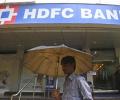
HDFC Bank has ensured that no bank will be able to match them in the near future without bleeding on margins.

Swift gains on Dalal Street this year have also led to a sharp surge in shares of equity market intermediaries like depositories, exchanges, and registrar and transfer Agents (RTAs). The stock prices of BSE, CDSL, CAMS, and KFin Technologies are up 24-283 per cent so far in 2023 when compared to a 9 per cent rise in the benchmark Nifty index. With the market buoyancy expected to keep up the pace, analysts believe these stocks are a good long-term bet despite the sharp rally, which can trigger an intermittent correction.

India's first $1 trillion company by market capitalisation (mcap) is achievable by 2032 and HDFC Bank and Reliance Industries (RIL) are seen as lead contenders, ICICI Securities said in a note on Monday. To achieve this, the shares of both the firms will have to appreciate at least 20 per cent annually for the next decade. ICICI Securities believes this is possible if India's gross domestic product (GDP) growth accelerates to 9 per cent per annum and corporate profitability cycle peaks. "Our calculations suggest that India's first $1 trillion mcap stock could emerge by 2032.
Equity benchmarks fell sharply on Thursday in line with an extremely weak trend in the global markets, with the Sensex plunging 1,154.78 points in early trade. Persistent foreign fund outflows and a spurt in crude oil prices also dampened sentiment. The 30-share BSE benchmark was trading 1,154.78 points lower at 53,053.75. The broader NSE Nifty tumbled 335.65 points to 15,904.65.

Among the main gainers were Jio Financial Services which jumped 4.99 per cent, Tata Steel (2.09 per cent), Maruti Suzuki (1.87 per cent), M&M (1.31 per cent) and Infosys (1.19 per cent).

The financial numbers for 2023-24 (FY24) of the four pure-play listed asset management companies (AMCs) have enthused the Street. All firms listed robust growth in net profit and revenue both during the January-March quarter (Q4) of FY24, as well as in full FY24. The strong performance comes amid a positive growth environment for the sector, led by tailwinds such as sharp growth in assets under management (AUM) and robust performance in equity offerings.
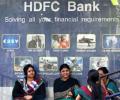
Customers would be able to make money transfers, pay utility bills and recharge their mobile and DTH connections with just one click and a single PIN entry
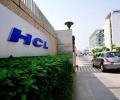
Shares of HCL Tech hit a fresh record high of Rs 1,118.55 on Friday, up 2 per cent on the BSE in intra-day trade, surpassing its previous high of Rs 1,101 touched on Thursday in intra-day deals.
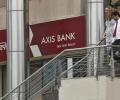
The April-June quarter (Q1) of the current financial year (FY25) may be soft for banks with loan growth moderation, net interest margin (NIM) pressures, and higher staff and credit costs inching up, according to analysts. Credit growth could ease due to the lagged impact of the Reserve Bank of India (RBI) tightening and deposit growth has weakened, and the current account and savings account (CASA) ratio has declined 10-370 basis points (bps) quarter-on-quarter (Q-o-Q) for many banks.

Domestic equity investors' wealth eroded by more than Rs 4.43 lakh crore on Monday as fears of a financial contagion triggered by one of the biggest bank failures in the US roiled market sentiments. After a strong opening, Indian stocks went into a tailspin with the benchmark 30-share BSE Sensex tumbling nearly 900 points to close at 58,237.85 points -- sliding for the third straight trading session. The NSE Nifty too declined 258.60 points to end at 17,154.30 points.
